

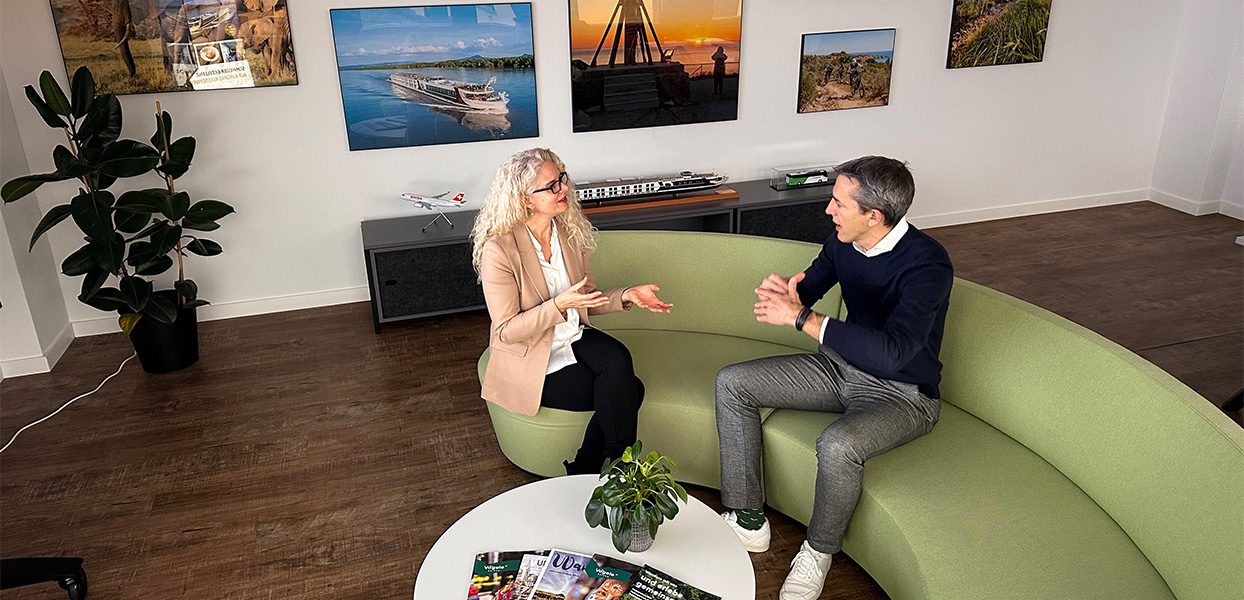
Partner Spotlight | Imbach & Vögele Reisen

Climate action, already included in your travel price: Imbach & Vögele Reisen integrate sustainability into every booking.

A fixed share supports Sustainable Aviation Fuel (SAF) and certified myclimate projects. SAF is purchased retrospectively based on real booking volumes in cooperation with the Lufthansa Group.

This makes climate responsibility a seamless part of every journey — simple, transparent, and impactful.

The Interview

You opted for a SAF bulk deal with the Lufthansa Group in which the SAF purchase takes place retrospectively, based on the actual climate contributions made by customers. Why was this low-risk, demand-driven model particularly important to you? 

At Imbach Reisen and Vögele Reisen, the climate protection contribution is automatically included in the sales price. Customers do not have the option to opt out, and since we invest 20% of the collected climate contribution in the purchase of Sustainable Aviation Fuel (SAF), the SAF bulk deal was the right solution for us. This allows us to review every six months how many people booked which of our trips and calculate the amount of SAF we can purchase accordingly.


The climate protection contribution is based on myclimate’s CO₂ methodology — an approach many customers are already familiar with. What role does this familiarity play in day-to-day sales activities, for example during the initial customer interaction or when answering questions, and where does it consciously reduce the need for explanation?

Customers’ familiarity with myclimate’s CO₂ logic plays an important role, as myclimate is a well-established Swiss non-profit organization whose climate protection projects are internationally certified and monitored. This credibility and transparency, combined with the scientifically based calculation of CO₂ emissions for each trip, consciously reduces the need for further explanation, as customers generally perceive the approach as reliable and easy to understand. 

You invest a fixed share of the revenue generated through the climate protection contribution into SAF. What was important to you when defining this share and why was it not an option for you to rely solely on traditional carbon offsetting?

That’s correct — for air travel, we invest 20% of the climate protection contribution in Sustainable Aviation Fuel (SAF) and 80% in a myclimate climate protection project. We deliberately chose this split because we see SAF as currently the most important technological solution for reducing CO₂ emissions in aviation in the short and medium term.

Relying solely on contributions to climate protection projects was not an option for us, as SAF can reduce CO₂ emissions by up to 80% over its entire lifecycle compared to fossil kerosene by creating a closed carbon cycle. This enables a more direct reduction of emissions within air transport itself, while climate protection projects continue to play an important role in addressing emissions that cannot yet be avoided.

You decided to integrate SAF directly into the travel price, while others rely on optional customer choices. What advantages does this clear approach bring for you — both in sales and in terms of impact?

The automatic integration of the climate protection contribution, including the SAF component, into the travel price means that our customers do not have to actively select anything additional. The advantage is that responsibility no longer becomes an extra decision.

In the sales process, this removes a potential barrier for customers. In terms of impact, it ensures that every flight consistently contributes to the purchase of SAF, creating a greater collective climate impact and actively supporting demand for sustainable aviation fuels.

Price is often seen as a barrier. How do customers react when SAF is included in the travel price, and which discussions are avoided as a result?

By automatically integrating the climate protection contribution into the travel price and not explicitly breaking down the exact financial amount, discussions about whether and how much should be invested in climate protection are largely avoided. The transparent display of CO₂ emissions and the carbon footprint per trip on each offer page ensures clarity and helps customers perceive responsibility as an integral part of the journey rather than a separate price component to be questioned.

Your climate protection contribution is integrated into the travel price without separately disclosing the amount. How do you address critical questions around transparency and what concrete proof do you provide that the SAF share is actually purchased?

Our transparency lies in disclosing the CO₂ footprint per trip in tonnes. We are convinced — and have also experienced this in practice — that this leads to fewer, if any, critical questions. If we were to disclose the monetary amount, we would likely receive more inquiries about whether this amount could be deducted from the package price.

On our website, we publish the ‘Emission Mitigation Certificate’ provided by you and thereby show customers how many kilograms of SAF we have purchased.

What was more challenging internally: building a solid understanding of SAF or maintaining a consistent stance in clearly defending this approach when facing critical questions and how did you anchor this decision within your organisation?

We introduced our teams to the production, impact, and benefits of SAF through presentations and revisit this topic regularly. In addition, we also informed our tour guides, as they are even closer to the customers. It is important to us that they are able to provide clear information about our overall sustainability commitment, and SAF in particular.

Many advisors wish for simple, clearly understandable integration models. How has the clarity of your approach specifically contributed to the confidence and relief of your teams in customer conversations?

The automatic integration of the climate protection contribution into the travel price significantly relieves our sales staff. They do not have to advise customers to make an optional contribution, since it is already included in the offer.

Where do you see the greatest scalability effect of your model – for customers, for your team, and for the overall impact of SAF?

The greatest scalability effect for customers lies in the simple, seamless integration of the climate protection contribution, making it easier for them to choose more sustainable travel. For our team, the scalability effect is in the efficiency and clarity of the sales process, as no additional advisory effort for optional climate protection services is required. For the impact of SAF overall, the greatest scalability effect is that, by making the contribution mandatory for all flights, a consistent and widespread contribution to SAF funding is achieved. As SAF is considered "the most important current technological solution" for reducing aviation emissions, this increases demand and helps both promote the expansion of production capacity and to foster the development of synthetically produced SAF using solar energy, etc.

For partners considering the integration of SAF in their travel packages: Which positive side effect of your decision only became clear to you in hindsight?

Acceptance among our customers is higher than expected. So far, we have received practically no negative feedback regarding this decision.

Where does your fixed integrated approach still encounter limitations and what would you advise partners who are hesitant due to potential internal or customer resistance?

With our current approach, we must invest the majority of the climate protection contribution in projects abroad. If we were to invest the entire amount in a project within Switzerland, the climate impact of our financial contribution would be significantly lower. To achieve the same impact with such a project, we would have to increase the climate protection contribution per trip integrated into the sales price to a level that would make our prices uncompetitive.

As our experience has shown — including confirmation from a scientifically conducted customer survey — there is virtually no resistance to be expected. The key is good and transparent communication as well as a trustworthy and comprehensive commitment to sustainability.

Are you an industry expert? Become part of the Lufthansa Group airlines eXpert program and stay ahead with exclusive product updates, booking tips, webinars, and member-only resources.